
Emergency Surgery, Recovery, and the Beautiful Mess of Being Human
I get a really "cool" new scar!
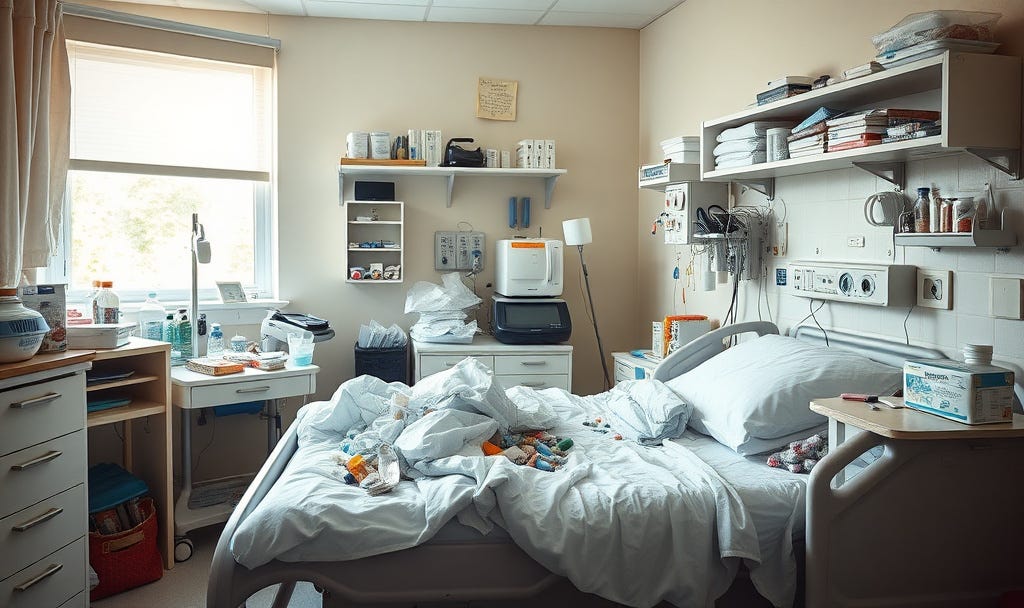
Nobody puts “12 hours in the ER, transfer by ambulance, and emergency hernia surgery” on their Sunday bucket list. But life isn’t interested in your plans. Instead, it tosses you into the fluorescent, sterile world of the hospital, shoves you into a paper gown, and strips you of every illusion of control you thought you had.
The Hospital: Cold Floors, Grippy Socks, and the Smell of Disinfectant
Let’s get real about the hospital. The air tastes like bleach and plastic. The floor is so cold your toes curl, but you’re issued those ridiculous grippy socks—bright yellow, like a warning sign for “fall risk.” Every surface is hard or sticky or both. The bed is supposed to help you heal, but no matter how you mash the buttons, you can’t get comfortable. You ask for more pillows, which helps for about 20 minutes. The sheets are scratchy. There’s always a faint beeping somewhere, and the hallway light slices under the door even when you try to cocoon.
And the indignity. The hospital gown hangs off you like a surrender flag. More people saw my ass in 36 hours than in the last 15 years—maybe in my whole adult life. If you need to pee, you have to call someone, and then they stand there like a prison guard while you try to pretend this is normal. There are straws in weird little cups that taste faintly of sanitizer, and every time you move, an IV line tugs at your arm. The silence is loud, and the noise is even louder.
The scariest part? The back-and-forth in your head. What if this is something worse? What if they missed something? What if my body never feels normal again? The ambulance ride is a bouncing, uncertain blur, every pothole a reminder that you’re not in control—of the ride, of your body, of anything.
When Your Body Puts on the Brakes (and Why It Does)
Here’s the truth nobody wants to hear: if you run yourself ragged long enough, your body will stop you. I’m always the one in motion—work, family, projects, helping others. I don’t just dislike slowing down; I resent it. But the human body isn’t built for endless hustle. Stress, lack of rest, pushing through warning signs—your nervous system keeps the score. Cortisol goes up. Your immune system tanks. Inflammation builds. Old injuries flare. New ones sneak in. Eventually, something breaks: your mind, your gut, your heart, or in my case, a chunk of muscle wall that decided it was done holding up the show.
It’s not just “mind over matter.” Bodies are designed to protect us—even if that means staging a full-blown revolt. We need rest, nourishment, boundaries, and a little grace. Self-care isn’t just bubble baths and candles; it’s answering your body before it has to scream.
Family Curveballs: When Life Decides It’s Game On
Of course, my own hospital drama wasn’t enough. A week before, my husband went ice fishing with my dad, got thrown out of a sled behind a snowmobile, and came back with a broken ankle, a couple of toes pointing in the wrong direction, and—because the universe loves a plot twist—a brand-new diabetes diagnosis. No warning, no symptoms, just “Congratulations, here’s your insulin prescription.”
Our house turned into a field hospital overnight. Suddenly, I’m learning wound care, insulin injections, and how to keep a grown man from trying to “just walk it off.” My kids are bouncing between grandparents and hospital rooms, trying to make sense of it all. There are pill bottles and medical bills and follow-up appointments, and the whole rhythm of our lives gets rewritten. And you know what? That’s recovery in real life. It’s not about being perfect; it’s about adapting, improvising, and holding onto each other through the chaos.
Recovery, Hospitals, and the Impossible Choices
Let’s talk about pain meds. Hospitals are full of them—rolling carts of temptation, all neatly labeled. For me, painkillers were never “the one,” but I danced with them enough to know the steps. So when the doctor asked if I wanted a prescription to take home, I hesitated. The pain was real, but so was the risk. I said no, even though it would’ve been easy to say yes. Not because I’m some recovery saint, but because I know myself. I know what it’s like to look at a bottle and think, “Just this once.”
But that’s not the only impossible choice. There’s the decision to be honest about your history with addiction when you know you could be judged, flagged, or treated differently. There’s advocating for what you need when you know the staff is drowning in work. There’s the fear: Will they believe me? Will they help me? Will I be safe?
Here’s what helped: I was honest. I asked for what I needed. I told them my history, my concerns, my wishes. And when I did, most of the staff responded with humanity. They talked to me like a person, not a diagnosis. They gave me choices. That’s not always the case, but it’s worth fighting for.
Advocating for Yourself: How to Speak Up When It’s Hard
Advocacy isn’t about being aggressive; it’s about being clear. You can be scared and still be your own best champion. Here’s what I said:
“I’m in recovery. Pain meds are risky for me. Can we talk about alternatives?”
“If I need something for pain, can we keep it minimal and have a plan for accountability?”
“I want to be honest. I hope you’ll work with me.”
And yeah, sometimes you have to say, “I know you’re busy, but I really need help right now.” You will not always be comfortable. Do it anyway.
The Noise, the Silence, and How to Sit Still
Hospitals are noisy—beeps, alarms, the squeak of rubber soles, the clatter of carts, the endless murmur of voices in the hall. But they’re also profoundly silent. In those quiet moments—when visiting hours are over, the lights are dim, and you’re left alone with the ache in your belly and the ache in your head—that’s when the work starts.
Sitting with silence is its own kind of medicine. It’s uncomfortable, sometimes terrifying. But if you can’t be alone with yourself, the world will always feel too loud.
What helps? Not just the usual “meditate and journal” stuff (though those are great, if they work for you). Try these out-of-the-box ideas:
For the restless: Doodle on your hospital meal napkin. Make up a story about the nurse’s shoes. Count ceiling tiles, but assign each one a memory.
For the anxious: Ask for a warm blanket and focus on its weight. Trace your breathing with your finger on your palm.
For the thinkers: Plan your “First thing I’ll do when I’m out of here” list. Write a letter to your future self.
For the young at heart: Make shadow puppets on the wall. Text a friend a really, really bad joke.
For the overwhelmed: Give yourself permission to feel everything—anger, fear, gratitude, boredom. All of it is valid.
There’s no right answer. Silence is not the enemy. Sometimes, it’s the beginning.
Recovery Scripts: What to Really Say to Your Doctor
Let’s get you some actual lines you can use:
“I need you to know I’m in recovery. I’m not here to drug-seek—I’m here because I’m in real pain and I want safe options.”
“Please don’t flag me in your notes as ‘drug-seeking’ just because I’m honest about my history. I want to get better, not high.”
“I’m nervous about pain management because of my past, but I need help. Can we come up with a plan together?”
“I’m scared you won’t take me seriously if I tell you, but I need you to know I’m a person who’s worked hard for my recovery.”
Say it messy. Say it scared. Just say it.
Rant Time: The Trolls, The Ignorant, and The Northwoods Doctor
Okay, let’s talk about the ugly side. Some people, even in healthcare, are complete assholes. I got a message from a doctor—yes, a real, credentialed “healer”—saying addicts are losers, clogging up the system, better off dead. Let that sink in. This guy works in the same system that took care of me. He probably walked the same halls.
But here’s the beautiful part: the community leapt in. People who’d been through it, people who’d worked in it, people who just have hearts big enough to call out cruelty. They showed up, told their stories, drowned out the hate. The hospital system was notified, too. Just know, somewhere in the Northwoods, there’s a doctor who’s both a professional and a disgrace.
And for every idiot hiding behind a fake profile, there are a dozen real people who will stand up and say, “No, you’re wrong—here’s what recovery really looks like.”
The Good, The Bad, The Ugly, The Beautiful
Recovery isn’t a straight line. You get pain and healing, setbacks and progress, family chaos and unexpected kindness, trolls and allies, awkward conversations and moments of fierce pride. It’s the whole damn spectrum.
Pep Talk & Call to Action: Progress is Progress
To anyone in recovery: Show up, even when you’re scared, even when you’re tired, even when you’ve got an IV in one arm and your ass hanging out of a hospital gown. You matter. Your honesty matters. Your progress—messy, slow, or sideways—counts.
To the professionals: Listen. Ask the hard questions. Treat us like people, not problems. You might be the only safe person someone sees all week.
To friends and families: It’s messy. Love your people anyway. Show up for the ugly days and the beautiful ones.
And to the trolls? Thanks for the engagement—and for reminding us why these conversations matter.
Progress is progress. Even if all you did today was survive, advocate, or just breathe. Keep going. You’re worth it.


