Monday, January 20, 2025

The Changing Language of Recovery: More Than Just Words


The Changing Language of Recovery: More Than Just Words

When I first entered recovery, I was labeled – meth head, junkie, pill head. Each word felt like a brand, a permanent mark that supposedly defined my entire existence. In my world, these weren't just words. They were a life sentence.

The Language Landscape: More Complex Than You Think

Language is deeply contextual. Depending on your geographic location, cultural background, and specific community, the stigmatizing language can vary wildly. What's considered acceptable in one region might be deeply offensive in another.

In my recovery journey, those labels – meth head, junkie, pill head – they weren't just descriptors. They were psychological handcuffs. I internalized them completely. If everyone called me a junkie, how could I ever be anything else?

The Evolution of Language: From Stigma to Support

Old LanguageNew Language
Substance AbuseSubstance Use or Misuse
Meth HeadPerson Managing Methamphetamine Use Disorder
Pill HeadPerson with Prescription Medication Use Disorder
JunkiePerson in Recovery
Stayed CleanMaintained Recovery
RelapseReturn to Use or Reoccurrence
Needle ExchangeSyringe Services
Medication is a CrutchMedication is a Treatment Tool
Convicted Felon/Criminal/ThugPerson with Convictions

The Devastating Cost of Stigma: A Deep Dive

Research paints a stark picture of stigma's impact. It's not just about hurt feelings – it's about life and death.

The Stigma Stoppers

  1. Reluctance to Seek Help
    Imagine standing at the edge of getting help, but the fear of being labeled stops you cold. Studies show this is a real and devastating barrier. The shame is often more paralyzing than the addiction itself.

  2. Internalized Shame
    When society repeatedly tells you who you are, you start to believe it. Self-stigma can reduce hope and worsen treatment outcomes. It's like being trapped in a psychological prison with walls built from other people's words.

  3. Systemic Discrimination
    Healthcare, employment, social interactions – stigma creates real-world barriers that can feel insurmountable.

A Dark Humor Moment (Because We Survive Through Laughter)

Let's be real. I've been called so many things, I could probably make a bingo card of stigmatizing terms. "Meth head" on B4, "junkie" on G56. Congratulations, society – you've turned my life into a really depressing game show where the prize is continued marginalization.

But Here's the Plot Twist

Despite all the labels, despite the stigma, recovery is not just possible – it's happening every single day.

The Bottom Line (And This Is Important)

Recovery isn't a linear path. It's messy, complicated, and deeply personal. Those labels? They're nothing more than someone else's limited understanding of a complex human experience.

A 2024 study highlighted something crucial: Every time we choose compassionate language, we open a door for someone who might be standing at the threshold of hope, too afraid to walk through.

Practical Steps for Changing the Narrative:

  1. Challenge stigmatizing language when you hear it
  2. Use person-first, compassionate terminology
  3. Share recovery stories that show the full humanity of individuals
  4. Recognize that recovery looks different for everyone

On a Good Note

I'm not just a person who "used to be" something. I'm a person who is continuously becoming. Those labels? They're just words. My life is the story.

To anyone reading this who feels defined by their past: You are so much more than the words used to describe you. Your recovery, your journey, your humanity – they cannot be contained by a single term.

Recovery is possible. And we're learning to talk about it right.-Belle-
Sunday, January 19, 2025

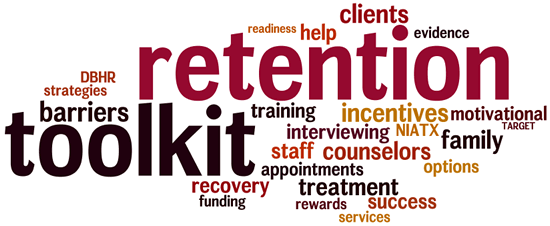
The New Era of Addiction Treatment: Understanding Contingency Management in 2025 (Or: How I Learned to Stop Worrying and Love the Reward System)


The New Era of Addiction Treatment: Understanding Contingency Management in 2025 (Or: How I Learned to Stop Worrying and Love the Reward System)

As someone who's walked both paths – first as a person in recovery and now as a substance abuse counselor – I've seen addiction treatment evolve dramatically. And let me tell you, if someone had told me during my early recovery days that we'd be literally paying people to stay clean, I would've thought they were smoking something themselves. Yet here we are in 2025, and that's exactly what's happening – with impressive results.

A Game-Changing Policy Shift (Finally!)

Remember when getting treatment was harder than finding a decent cup of coffee at 3 AM? Well, the Biden administration just eliminated a major barrier to contingency management, and it's about time. The big news? SAMHSA has increased the annual incentive cap to $750 per patient. That's right – we're now officially allowed to reward recovery with more than just a pat on the back and a stale cookie.

For those wondering what CM actually is (besides an excuse for my dad to say "back in my day, we just called it willpower"), think of it as a treatment approach that rewards recovery milestones. And no, it's not just throwing money at the problem – it's actually science-based, and it's proving to be one of the most effective treatments we have, especially for stimulant use disorders.

Addressing the Elephant (and Other Skeptical Animals) in the Room

Let's tackle the questions I get from both clients and fellow professionals – usually delivered with that "yeah, right" look I used to give my first counselor:

"Isn't This Just Bribing People to Stay Clean?"
Trust me, I had the same thought when I first heard about CM. But here's the thing – research consistently shows that external rewards actually help build long-term recovery habits. It's like learning to ride a bike – except instead of a helmet, you get gift cards, and instead of scraped knees, you avoid relapse. Win-win.

"What Happens When the Money Train Stops?"
Ah, the million-dollar question (though technically it's more like the $750 question now). Here's what I tell my clients: Think of CM like training wheels for your recovery bicycle. Eventually, you'll be doing wheelies in the parking lot of life without even thinking about the rewards. The data backs this up – by the time the program ends, most people have built solid recovery habits that stick.

The Numbers Don't Lie (And Neither Do Drug Tests)

Let's get nerdy for a minute, because the statistics are actually pretty mind-blowing. Recent studies show that CM programs are producing some of the highest success rates in addiction treatment, particularly for stimulant use disorders. And now we're seeing even better results thanks to technology – digital CM programs and smartphone apps are making it easier to track progress and distribute rewards.

What's really cool (and I mean actually cool, not "your aunt's Facebook memes" cool) is how we're implementing CM in 2025:

  • Instant rewards through digital platforms
  • Personalized milestone tracking
  • Integration with other treatment methods
  • Real-time progress monitoring

A Personal Note (Because We're All Human Here)

Look, I've been on both sides of this desk. I remember sitting in treatment thinking, "These people have no idea what this is really like." Now I'm the person behind the desk, and sometimes I still can't believe we've come this far. The research shows about 75% of people who develop an addiction do recover, and tools like CM are helping push that number even higher.

Looking Forward (Without the Rose-Colored Glasses)

The expansion of CM coverage and accessibility marks a significant shift in how we approach addiction treatment. It's like we finally realized that maybe, just maybe, positive reinforcement works better than shame and judgment (who knew?).

For anyone considering treatment or working in the field, I encourage you to learn more about CM. Whether you're a potential client or a fellow professional, understanding these developments could open new doors in your recovery journey or practice. And hey, if nothing else, it's probably the only time someone's going to pay you to pee in a cup.

Remember, the best treatment is the one that works for you or your clients. With these new policies and growing evidence supporting CM, we have another powerful tool in our recovery toolkit. And that's something worth celebrating – with or without a reward voucher.

P.S. - If you're reading this and thinking about getting help, do it. The hardest part is walking through that first door, but I promise you, it gets better. And now, it might even pay off – literally.-Belle- 

Why Addiction Isn’t About Willpower: Why That Truth Matters for Everyone

For more posts, come to the updated platform progressisprogress.substack.com Let’s just be honest: For years, I thought addiction was just b...